
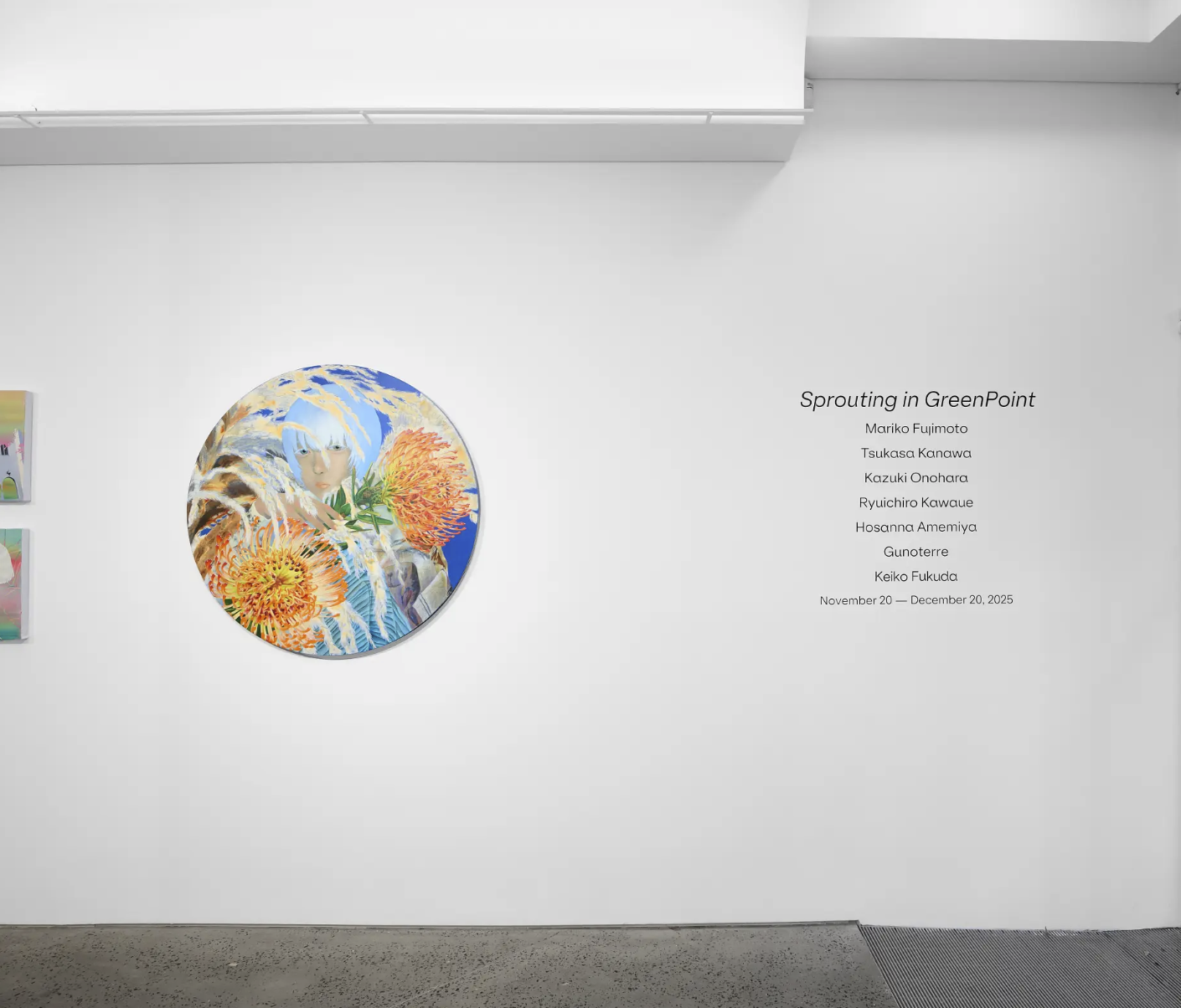
The Gallery of Contemporary Art (GOCA) by Garde presents Sprouting in GreenPoint, a group exhibition showcasing new works by seven emerging artists from the Brooklyn studio of renowned Japanese artist Tomokazu Matsuyama. On view from November 20 through December 20, 2025, the exhibition brings together Mariko Fujimoto, Tsukasa Kanawa, Kazuki Onohara, Ryuichiro Kawaue, Hosanna Amemiya, Gunoterre, and Keiko Fukuda.
What does it mean to grow in someone else’s garden? Sprouting in GreenPoint offers a compelling response—not with deference or imitation, but with seven distinct voices nurtured in proximity to one another. The show presents new works by artists from the studio of celebrated painter Tomokazu Matsuyama, whose own kaleidoscopic practice has made his Greenpoint studio a greenhouse for emerging Japanese artists in New York. The exhibition reads less like a showcase of protégés than a map of energetic divergences. These are not seedlings clinging to a central trunk, but shoots pushing outward. Mariko Fujimoto’s Aruqa (2025), for instance, is a radiant circular painting that brims with organic vitality—its use of crayon and acrylic suggesting a search for immediacy, intimacy, and tactile memory. Kazuki Onohara and Ryuichiro Kawaue, in contrast, orbit more conceptual terrain, toying with perception and spatial dissonance.
Yet there is a quiet cohesion at work. Themes of displacement, fragmentation, and transformation flicker through the works, echoed in the very idea of a shared studio located halfway between Tokyo and nowhere in particular—a Brooklyn warehouse, after all, being as liminal a space as any. In Tsukasa Kanawa and Keiko Fukuda’s contributions, nature appears as logic: unruly, cyclical, and sometimes inscrutable. The role of Matsuyama is felt as a structure—the kind that allows things to climb, collapse, and begin again. His studio, as the show’s framing makes clear, is a site of mutual exchange. Having experienced the loneliness of being a diasporic artist in New York, Matsuyama has inverted that condition into its opposite: a community where ideas, forms, and artists can coexist without consensus.
In a city where group shows often feel like exercises in curatorial neatness or thematic overreach, this one feels refreshingly lived-in. You sense that these artists have shared tools, stories, perhaps meals—and that what they’ve cultivated together is marked by curiosity, friction, and generosity. Sprouting, indeed.