
GoCA (Gallery of Contemporary Art) is making headway as one of Chelsea’s newest and most prolific galleries. With an emphasis on Japanese and other East Asian artists, GoCA’s 2,400 square foot gallery on W. 23rd St. possesses a Metabolic-meets-Brutalist architectural charisma that will make you think you have been transported to a Tadao Ando structure in Tokyo’s Roppongi Hills neighborhood. The current exhibition at GoCA presents three young New York-based Japanese artists whose individualized works assess the tensions between global fluidity - the transference of goods, peoples, and ideas from one place to another - and its polar opposite of closed-off insularity, especially as it relates to the cultural melting pot of a place like New York.
Hiroshi Masuda’s tonally muted portraits rendered in shades of white, black, and gray get down to the material and emotional complexities of the human condition. His bust-length portraits present an interesting dichotomy in which the torsos are depicted with the utmost realism whereas the heads are almost molecular, formless containers whose faces are quite cartoonish.
These deliberate disparities of appearance are contextually nuanced in a series of philosophical, spiritual, and political ideologies that Masuda has investigated, from the in-flux nature of our bodies as masses of atoms to Buddhist ethical principles. Even for those who are not versed in such belief systems and teachings, one can detect Masuda’s preoccupations with the multilayered, highly intricate corporeal and personal essences that make up our humanness. A more polychromatic series of paintings that comment on consumer culture continue these themes in a similar but, arguably, more allegorical manner.

Hiroshi Masuda (Japanese, b. 1987), Evan M. Johnsonun, 2025, spray paint, acrylic, and oil pastel on canvas. 16 x 12 in. (40.6 x 30.5 cm.)
Yuya Saito’s works lean heavily into urban street culture as an inviting space for those seeking a space of community, a theme that is relevant to both the urban realities of Tokyo and New York. “Flow-architecture” is the term used here to describe Saito’s work in which the material and symbolic embodiment of the ramp becomes the creative vehicle for his practice. Since the ramp as a motif is synonymous with skate culture, it should be mentioned that ramps as a platform upon which one moves is intended to not only provide ease of access, but also a sense of agency and command over one’s actions and movements. Saito’s painted ramps are elaborately colorful surfaces that glow with bold shapes and gestures in direct homage to the vibrancy of urban street art graffiti.
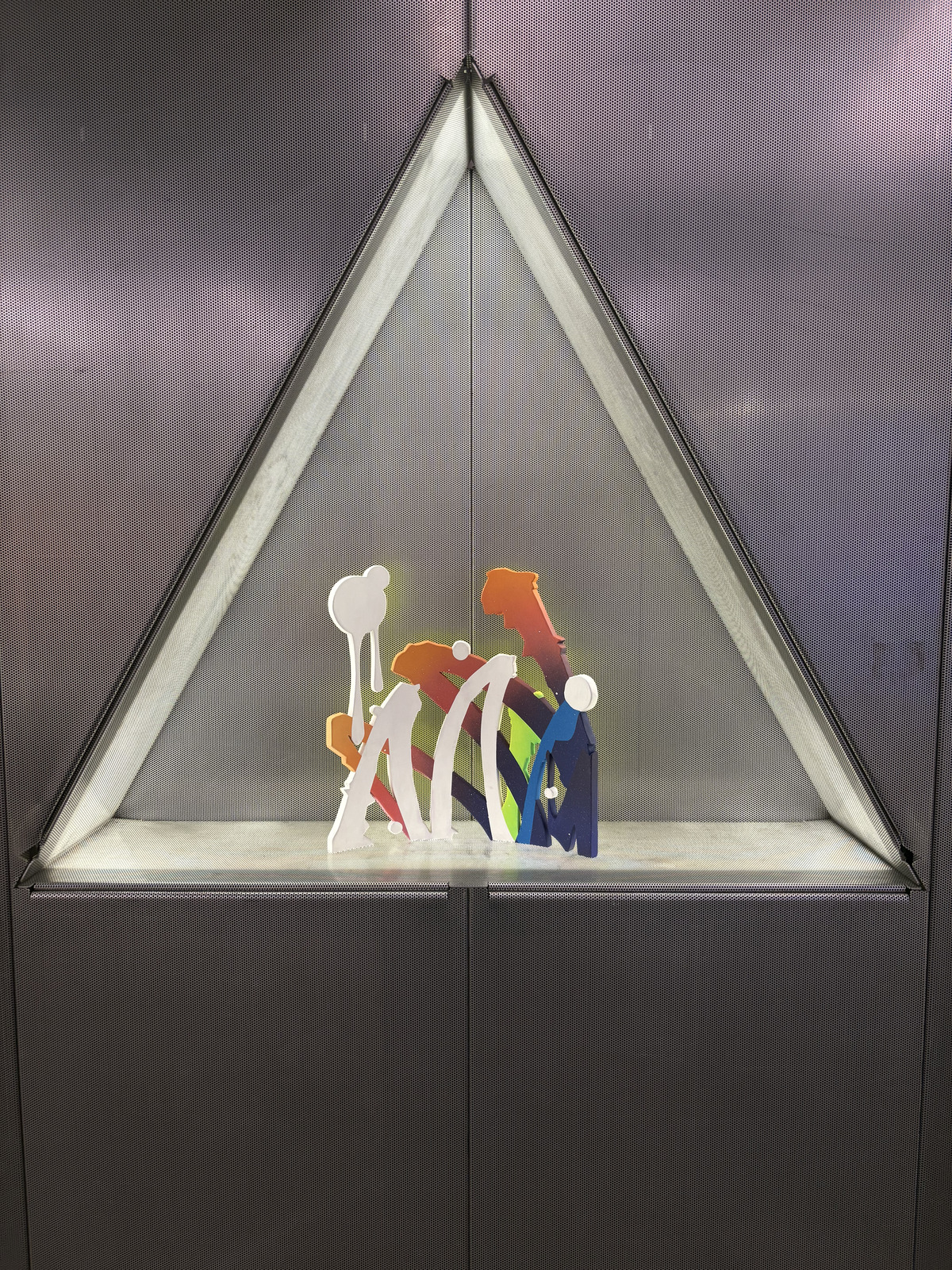
Yuya Saito (Japanese, b. 1982), FLOW_01, 2025, curved wood, acrylic. 24 x 24 x 6 in. (61 x 61 x 15.2 cm.)
Shinji Murakami, who coincidentally shares the same surname as Takashi Murakami, is a leading example of a younger generation Japanese artist whose work falls in line with Takashi Murakami’s Superflat, a Japanese style of art known for its literal flatness of aesthetics but also conceptual flattening of distinctions between Japanese and Western cultures. Murakami delves into the legacies of ukiyo-e, a form of woodblock art commonly associated with historic Japanese artistic conventions dating back to the 18th & 19th Centuries, by transferring its aesthetics into new media. LED matrix panel works showcasing an intricate network of electronic grids, switches, bulbs, and other technical features are moving image works in which colorfully abstract, atmospheric landscape scenes based on the traditional ukiyo-e style are saturated in garish shades that routinely shift positions or change colors across each screen.
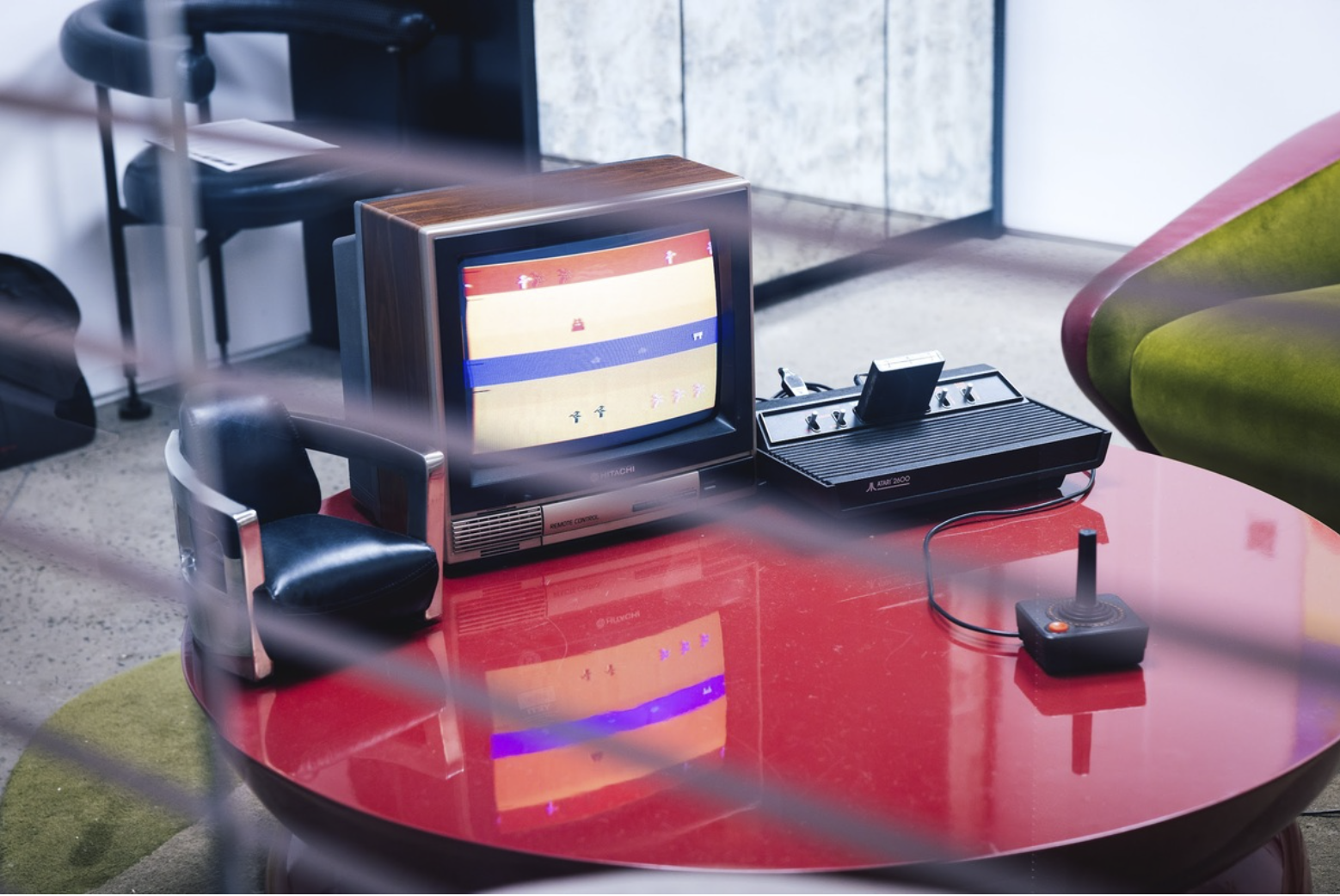
The simplified, pared down distant trees are brought into three-dimensionality in small-scale monochromatic sculptures that evince a commercial kitschiness to them. But Murakami does not stop here as he brings these ideas into another dimension - that of video games via a converted retro Atari device in which users may switch the abstracted landscape scenes at their own pace with the aid of a joystick. The ukiyo-e landscape has been revered for its two-dimensional spatiality in the painted form, but Murakami’s work here demonstrates how its aesthetics have evolved into new media, particularly through methods most digestible and accessible for a wider audience: video games, commercial-esque sculptural simulacra, and moving image displays.