When Form Becomes Force
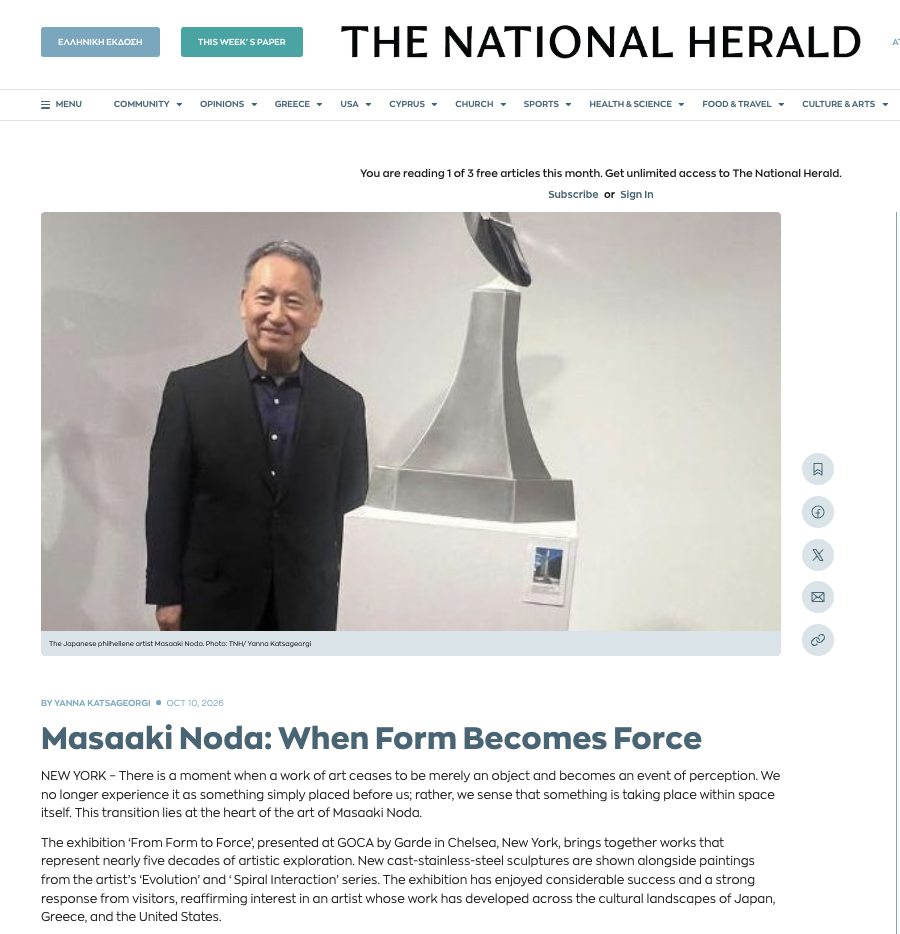
Review of Masaaki Noda's "FROM FORM TO FORCE" by Yanna Katsageorgi, published in The National Herald on October 10, 2026.
Read the article HERE.
---
NEW YORK – There is a moment when a work of art ceases to be merely an object and becomes an event of perception. We no longer experience it as something simply placed before us; rather, we sense that something is taking place within space itself. This transition lies at the heart of the art of Masaaki Noda.
The exhibition ‘From Form to Force’, presented at GOCA by Garde in Chelsea, New York, brings together works that represent nearly five decades of artistic exploration. New cast-stainless-steel sculptures are shown alongside paintings from the artist’s ‘Evolution’ and ‘Spiral Interaction’ series. The exhibition has enjoyed considerable success and a strong response from visitors, reaffirming interest in an artist whose work has developed across the cultural landscapes of Japan, Greece, and the United States.
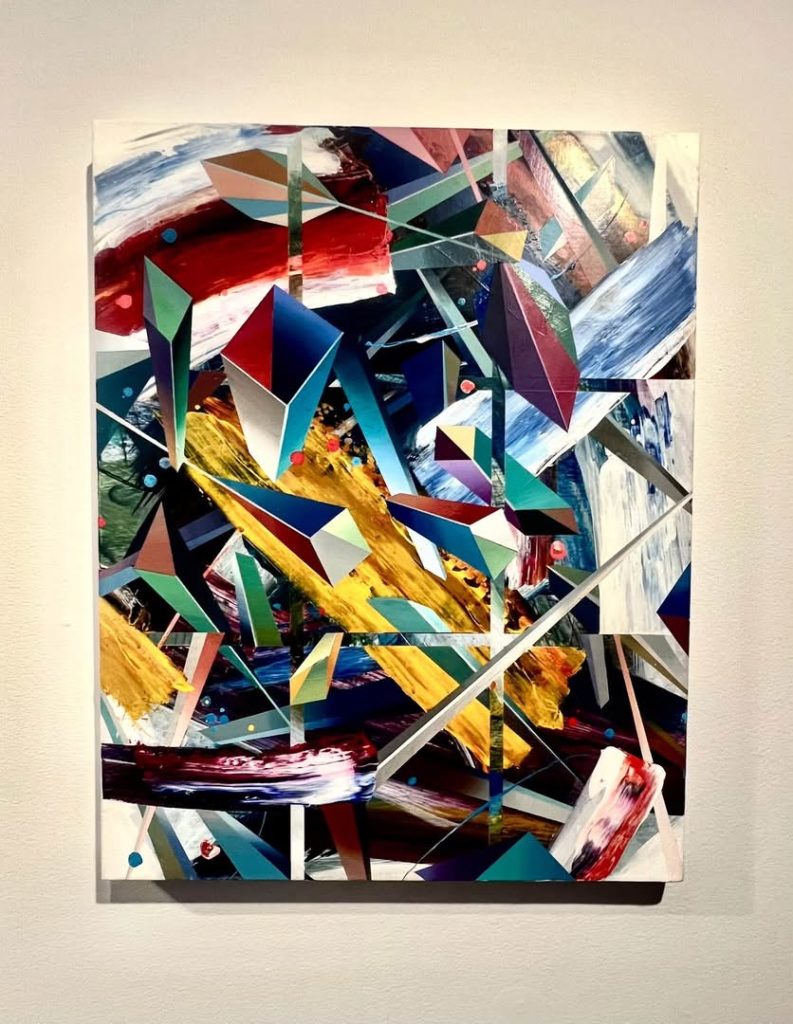
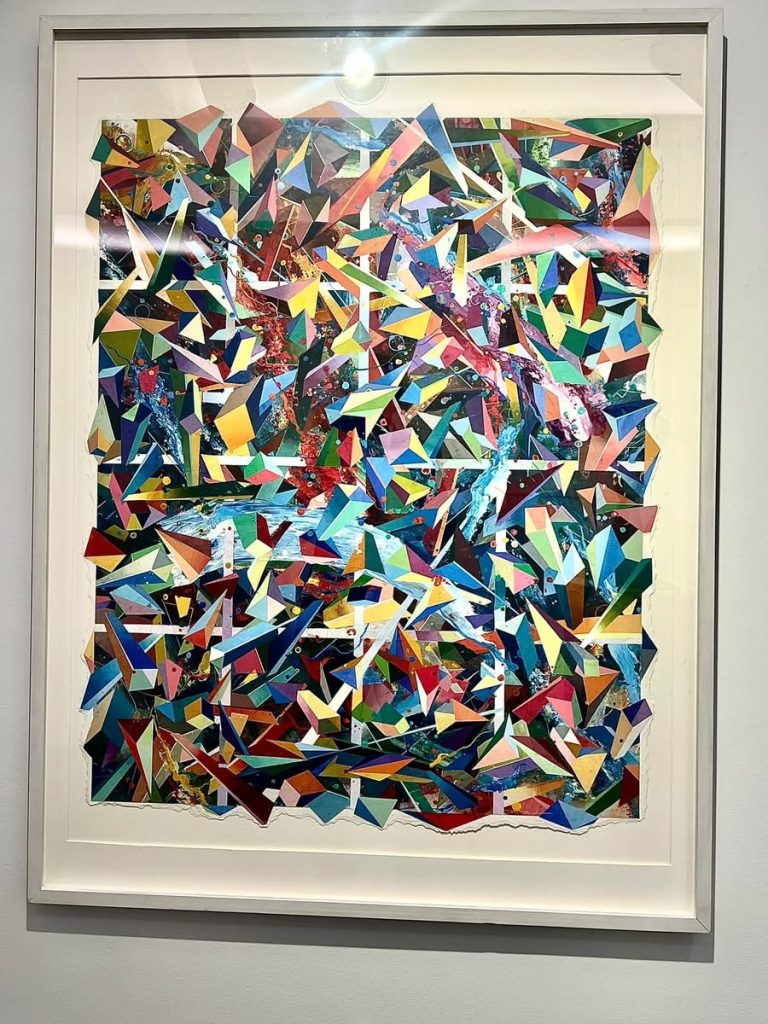
Works from Noda’s ‘Evolution’ and ‘Spiral Interaction’ series. The exhibition presents paintings from these series alongside his newest sculptural works. Photo: TNH/ Yanna Katsageorgi
The title of the exhibition is remarkably precise: from form to force. Noda’s development is not simply a progression from printmaking to painting and then to sculpture. It is a transformation in the very way visual experience is organized.
Born in 1949 in Fukuyama, Hiroshima, Noda studied at Osaka University of Arts. In 1977, he moved to New York and continued his studies at the Art Students League. New York subsequently became the principal arena of his artistic life. His early work in printmaking was concerned with geometric structures, overlapping planes, and the tension between color and form. Gradually, however, the forms ceased to remain still. Lines began to cross, surfaces to collide, and the eye was compelled to travel continuously across the picture.
His works are therefore not merely images that represent something. They are visual structures. A rising line creates direction; a curve opening outward suggests expansion; a dense mass produces weight, while a slender form ascending into space creates the sensation of release. The viewer does not simply look at these elements. The viewer experiences their relationships.
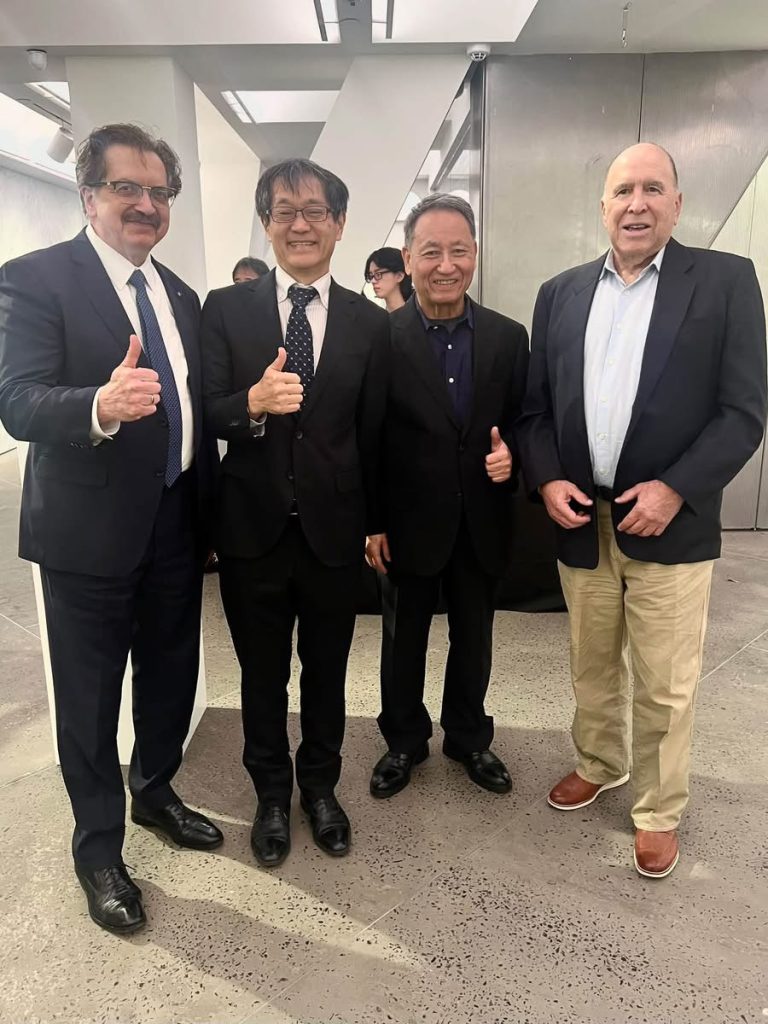
Left to right: Lou Katsos, Consul General of Japan in New York Ambassador Satoshi Katahira, artist Masaaki Noda, and Alan Sugarman. Photo: TNH/ Yanna Katsageorgi
This becomes particularly evident in Noda’s stainless-steel sculptures. Steel is inherently associated with weight and permanence, yet his sculptures often appear extraordinarily light— as though they might rise, turn, or take flight. The paradox is essential to his art: Noda makes weight appear as movement.
Light plays an equally important role. The polished surface of the metal does not merely decorate the sculpture; it receives and transforms its surroundings. Architecture, illumination, shadows, and the viewer’s own body enter the surface of the work. Consequently, the sculpture never possesses one completely fixed appearance. It changes as the viewer changes position.
The sculpture thus becomes an instrument of perception.
This principle also helps explain Noda’s profound relationship with Greece. His encounters with Greece, beginning in the 1990s, opened a new dimension in his work. Through his relationship with the collector and cultural patron Takis Efstathiou, and through journeys to places such as Delphi, Lefkada, and Athens, Noda encountered not simply the remains of classical civilization but a living visual and intellectual tradition.
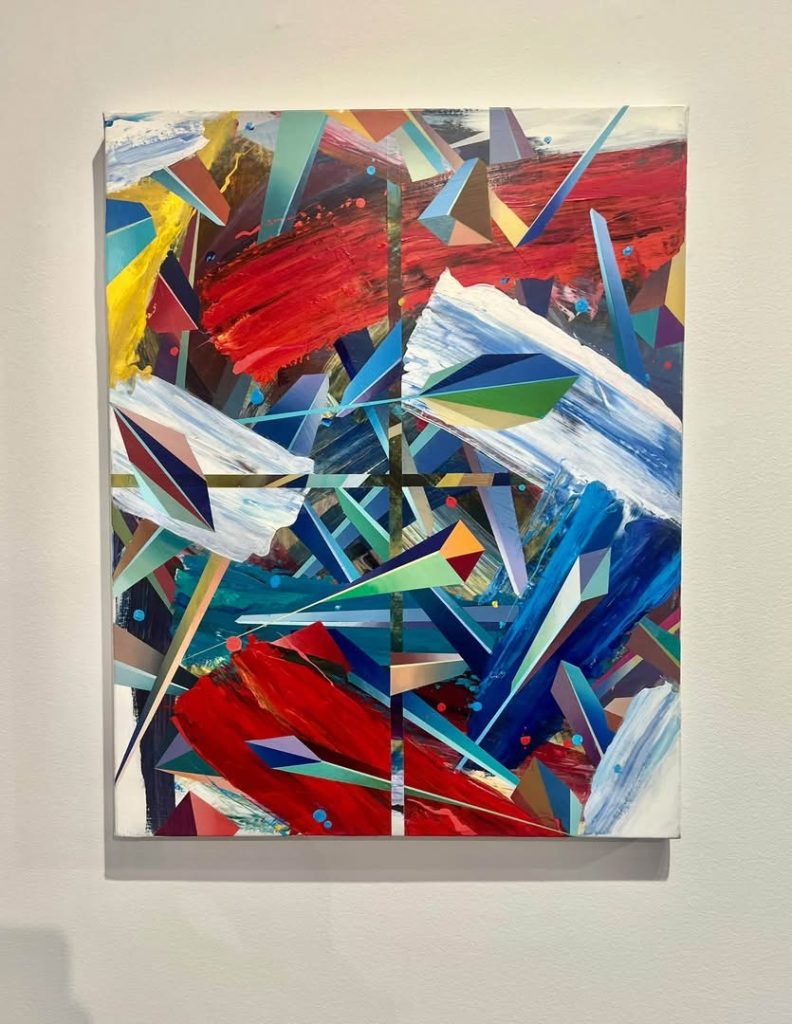
Works from Noda’s ‘Evolution’ and ‘Spiral Interaction’ series. The exhibition presents paintings from these series alongside his newest sculptural works. Photo: TNH/ Yanna Katsageorgi
Greek mythology became, for him, less a subject to be illustrated than a language through which movement, transformation, and human aspiration could be expressed.
His public sculptures in Greece make this particularly clear. At Delphi, ‘Apollo’s Mirror’ uses polished stainless steel to reflect the surrounding landscape, allowing the sculpture and its environment to become visually inseparable. At Marathon, ‘Spirit of Hermes’ transforms the ancient messenger into an abstract embodiment of speed, ascent, and movement. In Athens, ‘The Open Mind of Lafcadio Hearn’ reflects Noda’s fascination with cultural exchange, while in Lefkada, ‘Lafcadio Hearn: Odyssey of an Open Mind’ establishes a symbolic connection between Greece and Japan through the extraordinary life of Hearn.
Hearn is an especially meaningful figure for Noda. A man who moved between cultures, languages, and identities, he represents the possibility of belonging to more than one world. Noda’s own journey— from Japan to New York and from New York into a profound artistic relationship with Greece— echoes that same movement between East and West.
His contribution to Greek-Japanese cultural relations was formally recognized in 2023, when he was awarded the Gold Cross of the Order of Honor by the Hellenic Republic.
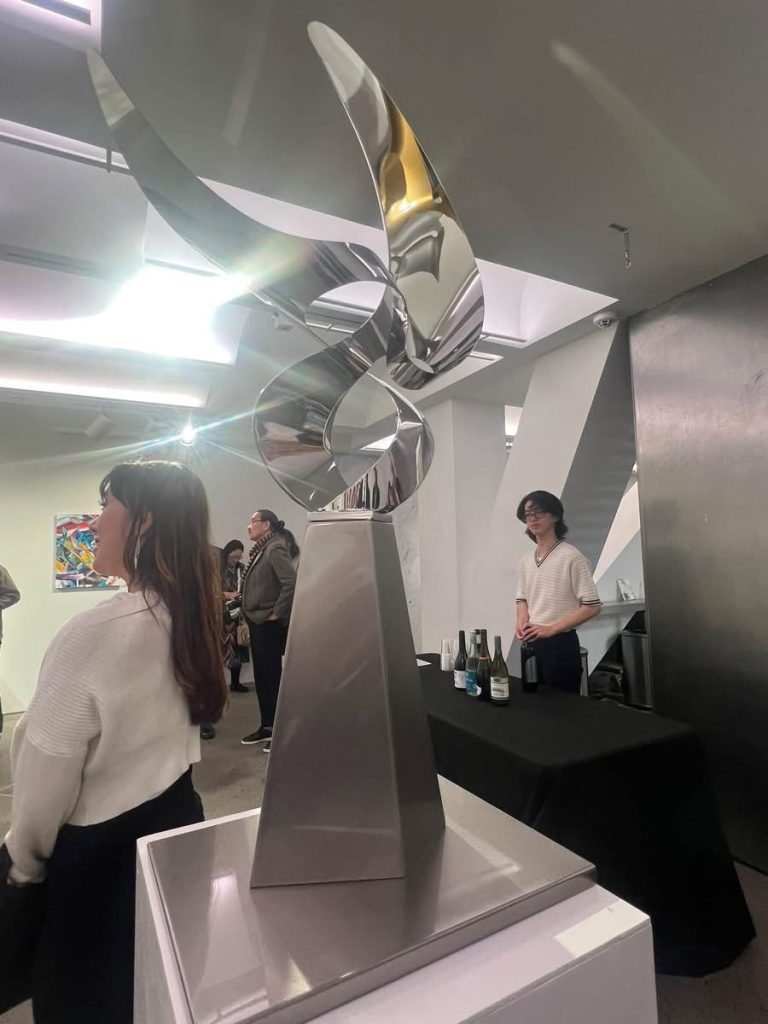
Examples of the new cast stainless-steel sculptures created by Noda for the exhibition ‘From Form to Force’. Photo: TNH/ Yanna Katsageorgi
In Chelsea, this long journey becomes visible in a new form. The paintings of ‘Evolution’ and ‘Spiral Interaction’ create fields in which color, geometry, fragmentation, and directional movement compete and cooperate. The sculptures then carry that visual energy beyond the limits of the canvas and into physical space.
What matters most is not whether we can identify a particular shape, but whether we can feel the forces operating within it.
Noda’s art demonstrates that balance is not necessarily stillness. A composition can be balanced while remaining intensely dynamic. A sculpture can be monumental yet seem weightless. A surface can be solid and simultaneously become a mirror of everything around it.
This is where Noda’s work becomes especially compelling. He does not ask the viewer merely to recognize an object. He asks us to experience the forces that make the object visible.
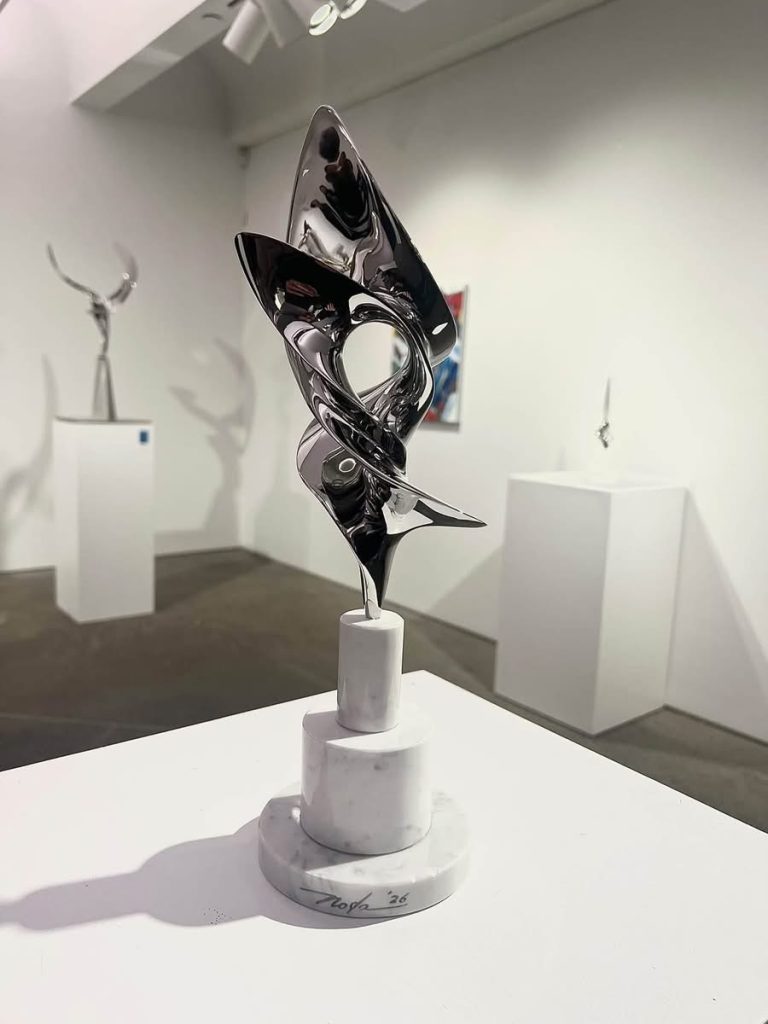
Examples of the new cast stainless-steel sculptures created by Noda for the exhibition ‘From Form to Force’. Photo: TNH/ Yanna Katsageorgi
The eye follows the line. The line creates movement. Movement produces tension. Tension generates energy. And energy transforms form into experience.
That is ultimately the meaning of ‘From Form to Force’: not simply the passage from one artistic medium to another, but the transformation of seeing into experiencing.
In Noda’s hands, form is never the final destination.
Form is where force begins.