
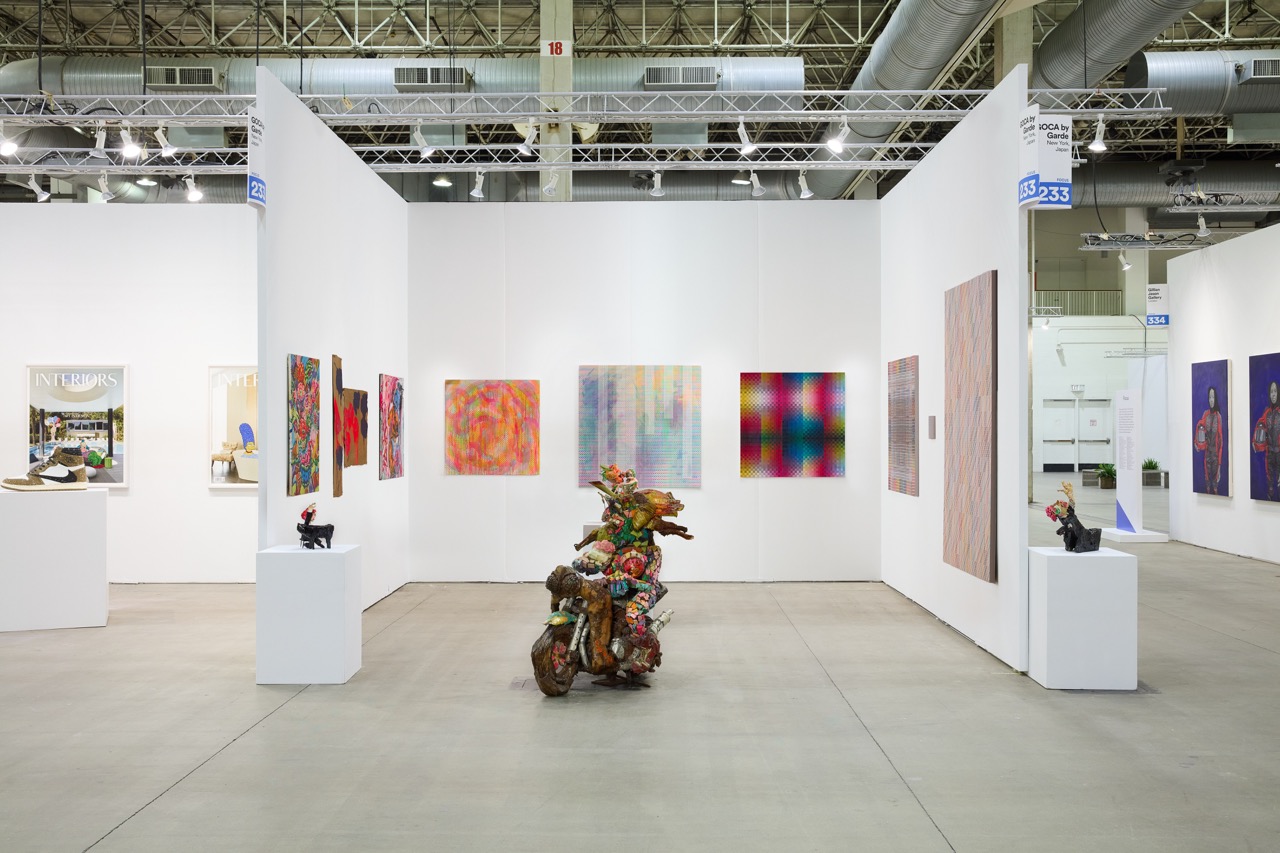
GOCA by Garde is pleased to participate in EXPO CHICAGO 2026 with a two-person presentation titled The Paradox of Control: Unconscious Order and Intentional Imperfection. Featuring Ushio Shinohara, a pioneering force of the post-war Japanese avant-garde, and Aya Kawato, who is expanding the frontiers of Op Art through her exploration of control and deviation, this exhibition seeks to redefine the boundaries between the controlled and the uncontrolled within artistic practice.
Ushio Shinohara’s creative process is an explosion of raw, physical impulse, appearing at first glance as a state of complete non-control. However, the trajectories of the fierce blows engraved on canvas through his signature Boxing Painting inherently possess an unconscious "order," cultivated through decades of repetitive physical experience. These impulses do not result in mere chaos, but emerge as the crystallization of a paradoxical control born from the resonance between body and space. This visceral drive is equally evident in his three-dimensional works, which are executed through a consistent "destructive order" from the initial selection of motifs to their completion.
In contrast, Aya Kawato initiates her practice through rigorous grid systems inspired by textile structures and neuroscience—a symbol of absolute rational control. Yet, the core of her inquiry lies in the subtle "imperfections" generated within this meticulous system. By permitting uncontrolled elements—such as the margins of error inherent in handwork and the unpredictable material behavior of paint—to intervene, the flawless grid begins to fluctuate. Through this intentional deviation, her work acquires a profound spirituality and materiality that actively evoke human somatic sensation.
While their technical methods reside in opposite extremes, both Shinohara and Kawato ultimately arrive at the same universal question of how humans confront processes and grant them distinct forms. Within the distinguished platform of EXPO CHICAGO, the intersection of these cross-generational practices transcends mere visual juxtaposition. We are confident that this highly innovative presentation, characteristic of GOCA by Garde's rigorous programming, will introduce a compelling new context for physicality and materiality in contemporary art.
AYA KAWATO (b. Nara, Japan,1988) lives and works in Kyoto, Japan. Influenced by her father’s career in neuroscience, Kawato gained an early awareness of how the brain mediates human perception. After studying traditional Japanese dyeing and weaving in Kyoto, she completed an exchange program at the École Nationale Supérieure des Beaux-arts de Paris. In 2019, she received her PhD from the Department of Intermedia Art at the graduate school of Tokyo University of the Arts. Her practice, centered on the theme "Control and Imperfection," focuses on abstract grid paintings that are grounded in both traditional Japanese textile arts and contemporary neuroscience.
Kawato has recently held solo exhibitions at Tokyo Opera City Art Gallery (Tokyo, Japan, 2023), Kyoto City KYOCERA Museum of Art (Kyoto, Japan, 2022), Pierre-Yves Caer Gallery, (Paris, France, 2020) and AIFA (Geneva, Switzerland, 2019). She has participated in numerous group exhibitions including The Secrets of Color from Impressionism to Contemporary Art, Pola Museum of Art (Kanagawa, Japan, 2024), Nippon Mania, Contemporary Art from Japan, Kunsthaus Kaufbeuren (Kaufbeuren, Germany, 2023) and Rêver 2074, FIAC 2017, Grand Palais (Paris, France, 2017). Her work is included in the collection of CHANEL G.K. and The University Art Museum at Tokyo University of the Arts, among others.
USHIO SHINHOARA (b. 1932, Tokyo, Japan) lives and works in New York City. Shinohara is a founding member of the Japanese Neo Dada group (originally known as Neo Dadaism Organisers), a radical collective known for its performative, anti-establishment actions. In 1969, Shinohara relocated from Japan to New York, where he has lived and worked since, becoming a vital presence in the city’s downtown art scene.
Shinohara is best known for his Boxing Paintings—action-based works created by striking canvases with boxing gloves soaked in ink or paint—and his ongoing Motorcycle Sculptures, begun in the early 1970s. Many of his sculptures are primarily constructed from found cardboard boxes, assembled with packing tape and hot glue, and embellished with an eclectic range of materials including polyester resin, jelly beans, artist-made mosaic tiles, wires, ice cream cones, and kanzashi hair ornaments. Across painting, sculpture, and performance, Shinohara’s work confronts themes of masculinity, cultural identity, and the collision between Japanese and American visual languages. His work is held in major public collections including the Museum of Modern Art, New York; the National Museum of Modern Art, Tokyo; and numerous international institutions.